
Bangkok comedy history
When Khao San Road had two comedy clubs
Two clubs, one backpacker crowd and a flyer war that turned Khao San comedy into a nightly street contest.
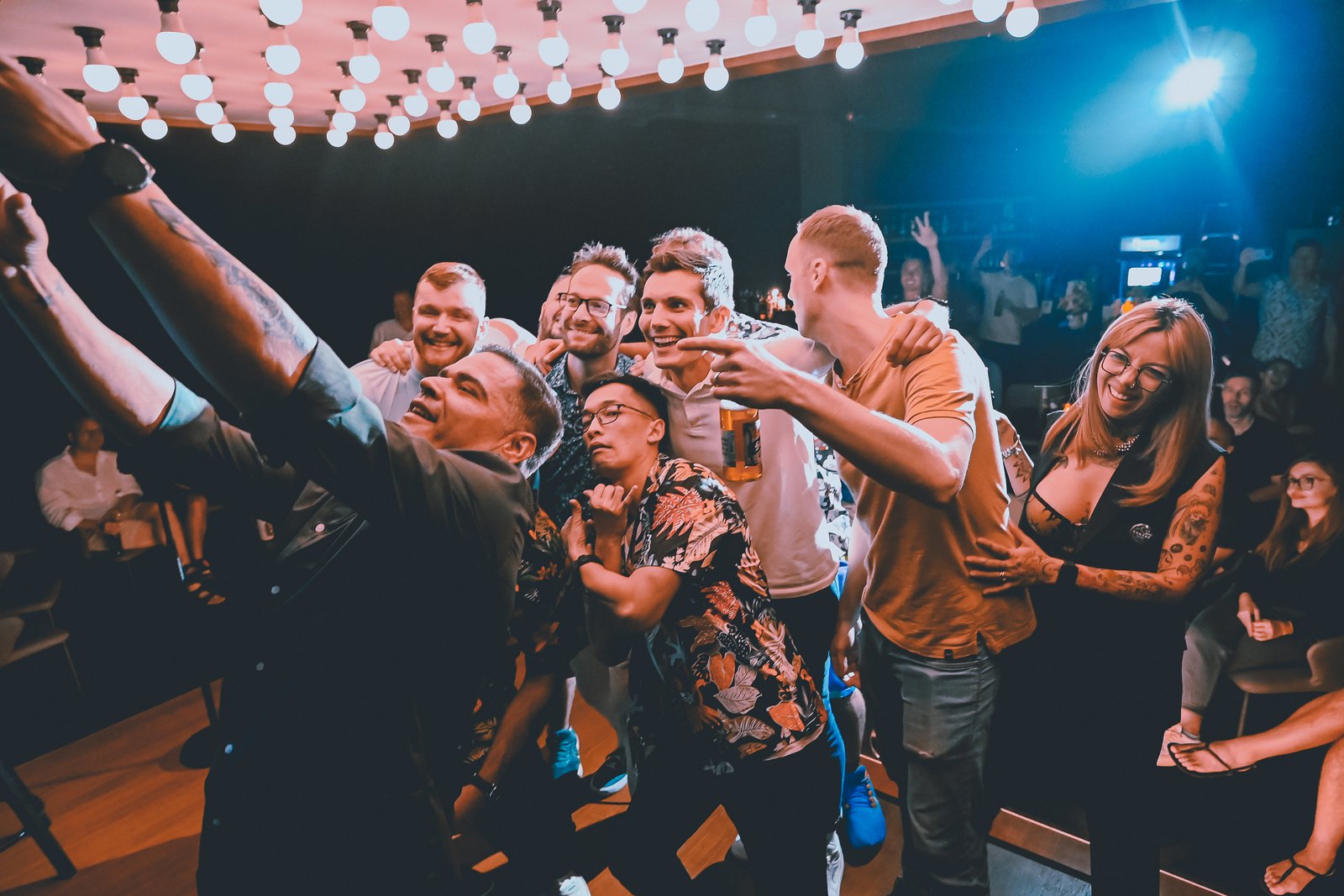
If you walked down Khao San Road at the right time in 2024, you could be handed flyers for two different comedy clubs before you had decided where to buy your first drink.
Both promised stand-up in English. Both were close enough to confuse anyone who had arrived in Bangkok that afternoon. Both wanted to turn the same wandering backpacker into a paying audience member that night.
This was a strange achievement. Khao San is famous for many things, but sitting quietly and listening has never been one of them. Somehow, among the bar signs, street food, tattoo shops and people trying to sell you a suit, a small English-language comedy scene took root. Then it split into two rooms. Then the rivalry became almost as entertaining as the shows.
The comedy scene began somewhere quieter
Bangkok's English-language stand-up scene predates the clubs on Khao San. Eric, Matt and Samson ran open mics at Roadhouse in Silom around 2008 to 2010. Samson also hosted one open mic at the Bull's Head, now the Royal Oak. Samson discussed his early involvement in a later interview.
Samson had already been a Bangkok character for years. He spoke fluent Thai and appeared in music videos and films, often playing the fat, sweaty farang. He wore loud shirts and attacked flyering with the energy of a man who could not imagine stopping. He once tried to flyer my dad. That was when I realised we were never going to beat a man so determined.
Samson eventually opened Khaosan Comedy Club in 2017. In that later interview, he said he built the physical room himself. It was a tiny detail that suited the early scene: if Bangkok did not have the comedy club you wanted, you found a room, built a stage and started one.
The location changed the audience. A pub open mic relies on people knowing it is there. Khao San supplied thousands of people who had no plan beyond the next few hours. They might never have heard of a Bangkok comedian, but they understood the offer on the flyer: come inside, escape the heat and watch a show in English.
That room gave local comics more stage time and visiting performers somewhere to find Bangkok's comedy scene. It also proved that stand-up could become part of a Khao San night out rather than a special event people planned days in advance.
The club's influence is easiest to see through the people who started with Samson. Chris Wegoda and Lex Morales both started with Samson, although through different doors. Wegoda came through Samson's improv classes, as he later recalled, before going on to build The Comedy Club Bangkok. Lex worked on Khao San for Samson before starting shows of his own, including FunwithLex at Live Lounge. Justin St-Denis and Chris Raufeisen also worked on Khao San; St-Denis and Raufeisen performed and flyered for the club. They learned comedy and sales on the same shift: do your time on stage, then head back outside and persuade the next audience to come in.
That shared history changes the story of what came later. New shows meant more stage time and more people trying ideas of their own. They also meant that former colleagues could become competitors. The same small group who had helped establish comedy on the street began building separate audiences, formats and identities.
RAW moves the family tree across town
St-Denis and Raufeisen started RAW at Live Lounge, upstairs from The Sportsman on Sukhumvit Soi 13 near Nana. It became one of Bangkok's longest-running open mics, a Wednesday-night room where touring professionals, experienced locals and people attempting stand-up for the first time shared the same bill.
Justin had already spent years headlining with material about expat life. Chris co-produced the room. RAW kept the rough edge of an open mic on purpose: some jokes worked, some died, and everybody in the room knew which was which.
Even the doorman had an improbable second act. Ric Diez came up with the RAW crew while working the door. In 2023, he appeared on Kill Tonyin Austin and won one of the show's Golden Tickets. Then, instead of quietly enjoying a standing invitation to return, he challenged regular Hans Kim for his job and put the ticket on the line. A Bangkok comedy doorman had talked his way into an arena-show rivalry on one of the world's biggest comedy podcasts.
RAW shows how far the Khao San lineage travelled. People who had worked for Samson did not merely leave and disappear. They created another durable room, developed comics of their own and sent at least one former doorman into international comedy notoriety.
The second club arrives
The Comedy Joint announced its Khao San opening in September 2023. Bangkok Comedy's surviving archive starts a month later, on 26 October, and quickly becomes chaotic in the best possible way.
Phil Koo was one of The Comedy Joint's early cofounders. Audiences later saw him billed as Phil Koobeedoo, hosting Bangkok Dangerous, but his place in the story begins before the open mic. He helped build the club itself.
There were touring headliners, first-timers, resident showcases and open mics. Best Show On Khaosan! appeared in November 2023.Local Legends became a regular fixture in 2024. The Tuesday open mic gave new comics somewhere to discover whether the joke in their head could survive contact with a room full of strangers.
Arnie Pie appeared across shows with titles including Thunder From Down Under and The Future of Thai Comedy. Trevor Lock, Christy Inhulsen and Charles The French all appeared in contemporary coverage of the room. Some nights were polished showcases. Others had the unpredictability that makes a small comedy room fun: a performer could be brilliant, a backpacker in the front row could become part of the show, or a new comic could discover five minutes was much longer than expected.
The archive now holds 167 posters. Together they look less like a clean entertainment calendar and more like the wall of a venue that kept trying things: loud titles, visiting faces, late shows, early shows, open mics and formats that changed name as quickly as the crowd outside changed.
Raufeisen later returned to Khao San to work at The Comedy Joint and try to save the room. The move brought the family tree back to the street where it had started: a performer who had flyered for Samson, left to build RAW near Nana, then came back to help another Khao San club survive.
The flyer war
The two clubs were selling to the same people on the same streets. That meant the rivalry did not live safely online. It was out on Khao San every night, in the hands of flyer teams trying to catch visitors before the other room did.
To someone inside the scene, Khaosan Comedy Club and The Comedy Joint were different businesses with different owners, performers and histories. To a traveller walking past with a Chang in one hand, the distinction was less obvious. “Khaosan Comedy Club” and “The Comedy Joint Khaosan Bangkok Comedy Club” could easily sound like two ways of describing the same place.
That confusion turned the road into a nightly contest. Every undecided group mattered. Every hostel recommendation mattered. Every person who followed the wrong map pin or arrived holding the other club's flyer became part of the story.
The competition also gave comics options. Performers could find more stage time, and audiences had more than one show to choose from. But Khao San had not suddenly produced twice as many comedy fans. The clubs were dividing the same stream of travellers, many of whom had not known they wanted stand-up until somebody put a flyer in their hand.
When the rivalry went public
In December 2025, the rivalry turned into a filmed confrontation between the two club owners. It was the kind of moment that made everything before it look like foreshadowing. Real life was messier.
The Comedy Joint's final event in the surviving archive is dated 5 November 2025, before the filmed confrontation. The video showed how bad the relationship had become; it does not neatly explain why the physical room closed.
The more interesting history is how a niche scene became crowded enough for that rivalry to exist in the first place, and what the people involved built next.
What happened to the room and the comedians?
The Comedy Joint's physical Khao San room closed. Its archive ends with more than two years of posters and event listings: Local Legends, open mics, resident acts, strange one-offs and touring comedians passing through Bangkok.
The people did not vanish with the room. Producers took formats elsewhere. Hosts found new stages. Comics who had learned to perform for jet-lagged tourists, expats, locals and occasionally hostile front rows carried those skills into other Bangkok shows. Some of them are listed in the Bangkok comedians directory.
A July 2024 guide to Bangkok's comedy rooms catches another branch in mid-move. It lists Callback Comedy Siam at Queen Bee on Thursdays. That was Pulé's show, but it was not a clean handover from one man to another. Samson had lost his Khao San club during COVID, and Samson and Pulé worked the Queen Bee gig together. Pulé no longer uses the Callback name. In August 2026 he began producing international stand-up showcases across town at Santi Social Space as Fat Rabbit, including the venue's Saturday grand-opening comedy night. Samson returned to Khao San to reclaim his old territory.
That is the next part of this story: the people who built the Khao San scene, the nights they remember and where they are performing now. Arnie Pie and the Soi Funny shows, KC King and the early Tuesday open mic, the Local Legends regulars and the people who worked both sides of the rivalry all have a version worth recording.
Khao San was one branch of a citywide scene. The Comedy Club Bangkok, the long-running Sukhumvit institution, developed alongside it and gave local and touring comics another route to a Bangkok stage. The Comedy Laughter Lab is newer, running English- and Thai-language comedy and collaborating with other producers around the city. When The Comedy Joint closed, its people remained part of a scene already spread across Bangkok.
After The Comedy Joint closed, I went back to perform at Khaosan Comedy Club. It felt like closure. Samson welcomed us warmly, then went straight back to fighting to fill the room as hard as he ever had. Nothing had changed.
His phone screen was cracked to hell, but he was still recording himself on it and working on his set. He told offensive jokes in fluent Thai to the locals who had come to see him. Some of them recognised him.
That night made me understand why Samson is perfect for Khao San. He survives, and so does the street. Both are a bit loud, a bit cringe and popular day in, day out. Both have an unapologetic energy that is rare in Thailand.
Khaosan Comedy Club has its own venue page. Because its programme changes, check the venue directly rather than relying on an old article for tonight's schedule. The posters and dated listings from the closed Comedy Joint room remain in The Comedy Joint archive.
How this history was assembled
The linked interviews and contemporary coverage support the public milestones. Dates, show names and poster totals come from Bangkok Comedy's surviving event archive. The backstage details and Samson stories are my own memories of working in the scene.